

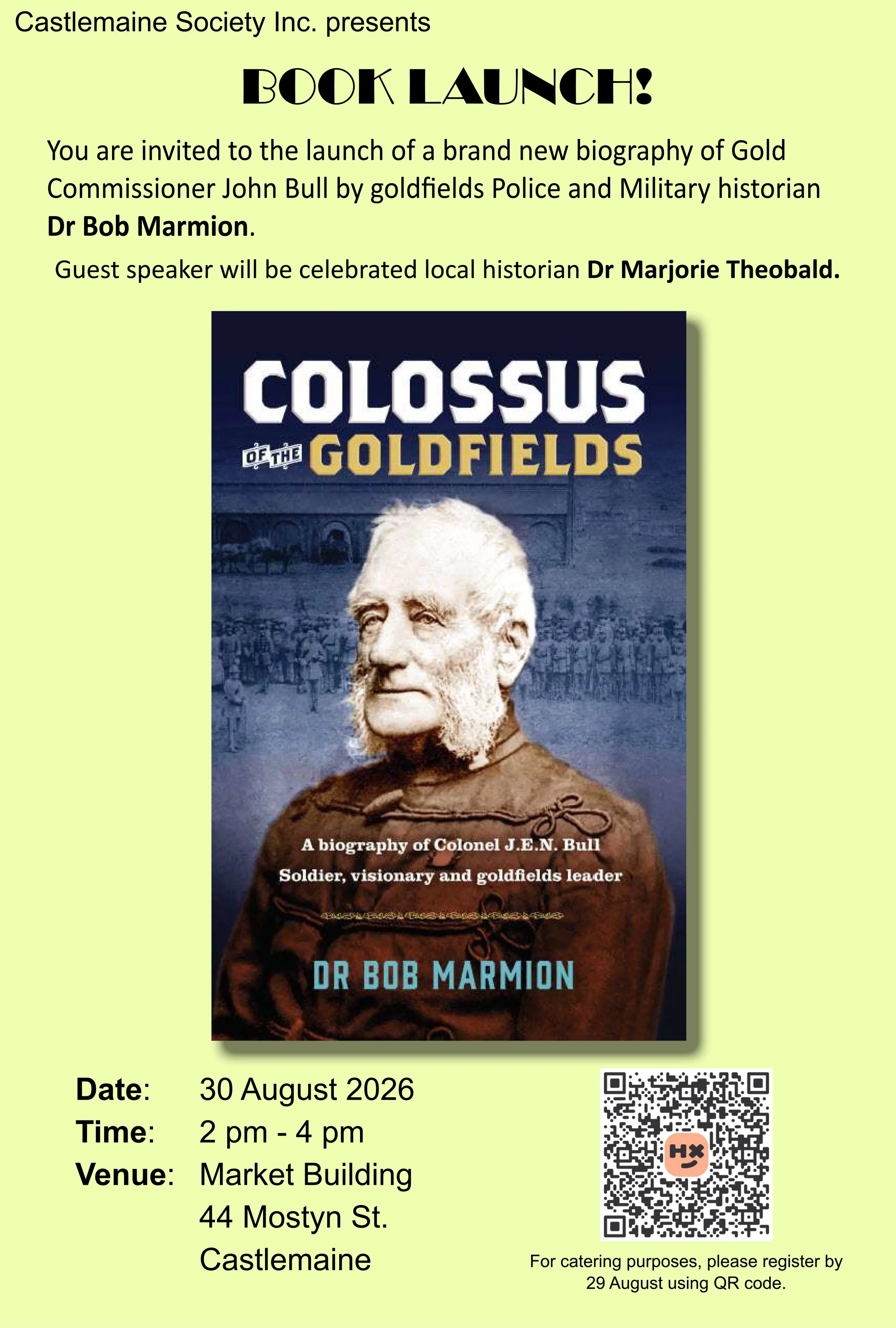
Historian Dr Bob Marmion is launching his biography of J.E.N Bull, a major figure in the history of the Victorian goldfields. The launch is being held in Castlemaine on 30 August 2026, and anyone interested in Victorian colonial history is encouraged to attend. Tickets available here.
Dr Bob Marmion is a full member of the Professional Historians Association (Vic). He is an accomplished historian and educator with many years of experience. He has a special interest in Australian military history and Victorian colonial history and has spent many years researching and writing about Victoria's defence history from 1803 through to 1945.
Back cover description of Colossus of the Goldfields:
Colonel John Edward Newell Bull was one of the most influential people on the Victorian goldfields in the 19th century. He was a real man of the times – Imperial soldier, social reformer, engineer, magistrate, goldfields administrator and civic leader.
Born into a British Establishment family in 1806, he was heavily influenced by his Christian faith, his father’s military service and the prevailing liberal thinking of the time.
In the 1840s, he was responsible for building the main western highway across the Blue Mountains west of Sydney. After leaving NSW in 1852, he went onto have a stellar career on the central Victorian goldfields, initially at Bendigo and then at Mount Alexander.
During the early 1850s, the goldfields were a hotbed of unrest, crime and change. John Bull took a very liberal approach to digger agitation. He recognised that the miners were not anti-Establishment but rather they were complaining about the conditions on the goldfields. He listened to the miners and attempted to address their grievances. This approach avoided the rebellion and bloodshed at Eureka a year later.
Bull was to play a major role in the establishment of Castlemaine as a town. He was involved in setting up the local municipalities, hospitals, schools, churches, sporting clubs and the local Volunteer Rifle Corps to name a few. Records show that he was involved in at least 32 organisations.
John Bull was caught up in a number of legal disputes in later years which eventually led to him being declared bankrupt. He eventually lost all his property and possessions.
He died at Goulburn in New South Wales in 1901.